Athena Engineering S.r.l.
News

Centrifugal Pump Overpressure Rupture Prevention

2026-10-19 0 Leave me a message

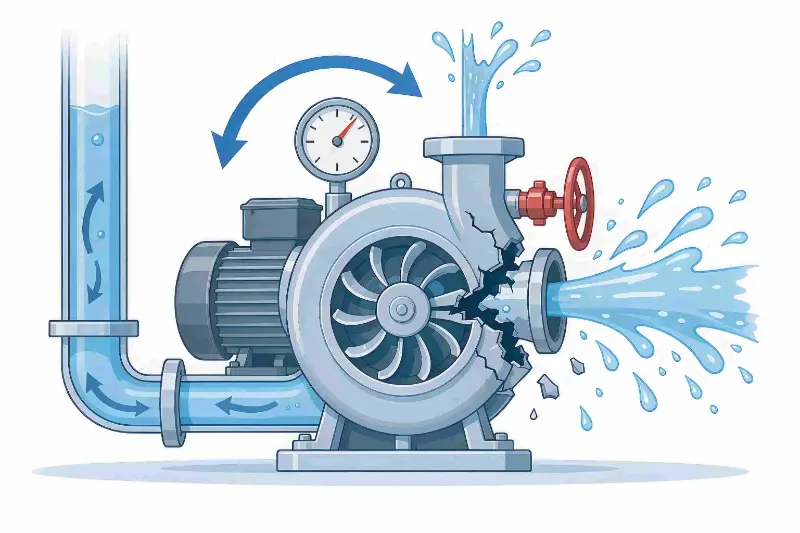
Figure: Schematic of closed-valve pressure buildup caused by discharge valve closure, resulting in pump casing rupture and medium ejection

Most pump body ruptures stem from dead-heading (closed-valve pressure buildup), erroneous remote start-up, and failures of automatic interlocks. This article addresses manual, remote, and automatic start/stop scenarios to explain valve verification, operating procedures, and instrumentation interlock maintenance, thereby preventing centrifugal pump overpressure rupture incidents.Teffiko has always prioritized centrifugal pump operational safety and provides complete safe operation and maintenance guidance for pump body rupture hazards. To fundamentally avoid such incidents, one cannot rely on hardware protection alone; valve verification, remote confirmation, and automatic interlock management must be applied to every start/stop operation.

Core Causes of Pump Rupture

Dead-heading (operating against a closed valve) is the physical root cause of the vast majority of pump body ruptures, and automatic control systems amplify this risk:


  • Starting the pump with both the inlet and outlet valves closed, the impeller continuously agitates the trapped liquid; mechanical energy is converted into heat, the liquid vaporizes and pressure rises, and within a short time it exceeds the pressure rating of the pump casing;
  • When the pump is started remotely from the central control room, operators cannot confirm valve status on site, making it easy to start up blindly after maintenance when valves have not been reset;
  • When level-triggered automatic start-up occurs, the line valves may still be closed for maintenance, and the pump then runs pressurized with no one on site;
  • Low-flow and high-temperature interlocks that go uncalibrated for extended periods fail to protect, and the system cannot automatically shut down and relieve pressure after overpressure.


Industrial Accident Case Study

At a small-to-medium-sized chemical raw material storage tank facility, after maintenance on a storage-tank transfer centrifugal pump was completed, the maintenance crew restored the equipment but forgot to open the discharge valve, then switched the pump to automatic mode. The pump started and stopped automatically based on tank level signals, with no one on site. When the tank level rose to the set trigger value, the PLC system started the centrifugal pump automatically. The liquid in the sealed pump chamber was continuously agitated by the impeller; within just 90 seconds the medium rapidly heated up and vaporized, and the pressure inside the pump kept climbing. Because the plant's low-flow interlock had not been calibrated for over two years, its sensor seized up and failed, and no shutdown protection was triggered. Eventually the pump casing ruptured and the high-temperature medium sprayed outward, destroying on-site equipment and forcing an emergency production-line shutdown, resulting in substantial repair and downtime losses. The post-incident investigation report identified two root causes: failure to re-verify valve status on site after maintenance, and the safety interlock having long gone without functional testing.

Conclusion: Unattended operation + valves not reset + failed interlocks—the rupture resulted only from the combination of these three factors, and could have been avoided if any single one had been controlled.

Manual On-Site Pump Start: Valve Position Verification Is the First Line of Defense

Strictly Verify the Status of All Valves

Before starting the pump, every line valve must be confirmed item by item to prevent starting with valves closed:


  • Main process line: keep the suction valve fully open to ensure liquid enters the pump chamber smoothly;
  • Keep all auxiliary valves such as vent valves, drain valves, and blowdown valves closed;
  • Open the pump body air release valve to complete priming and venting, expel all air from the pump, and prevent cavitation and dry running;
  • Keep the discharge valve slightly open or fully closed; never start the pump with both the inlet and outlet simultaneously blocked.


Incorporate Valve Checks into a Standardized Checklist

Valve open/closed positions are critical control points for ensuring safe pump operation and must be formalized in equipment work instructions and start-up checklists. Operators should confirm each item by checking it off, eliminating reliance on experience and reducing human error through institutional controls.

Remote Central-Control Pump Start: An On-Site Confirmation Step Is Essential

Remote start-up is a high-frequency scenario for pressure-buildup ruptures; relying solely on the central control screen cannot confirm the actual on-site conditions:


  • Before the control room issues a start command, the pump must not be started with a single click;
  • When operators cannot go on site to verify the valves, an on-site inspector must be assigned to physically confirm that all valves have been reset to the correct positions;
  • Only after receiving on-site confirmation may central control issue the start command, preventing a mismatch between the control screen and the actual on-site valve status.


Automatic Start/Stop Pumps: Focus on Preventing Valves from Being Left Unreset After Maintenance

Many tank emptying pumps rely on level instrumentation and PLC programs for automatic start/stop and run unattended, which makes the risk even higher.

On-Site Re-Inspection Is Mandatory Before Engaging Automatic Mode

After maintenance or pipeline work, and before switching to automatic control mode, all valves must be re-verified on site once again: inlet valve fully open, discharge valve at its start-up preset position, and all vent valves closed. Typical risk scenario: when the tank level reaches a high point, the automatic control system starts the pump, yet the post-maintenance discharge valve remains closed, directly creating dead-head pressure buildup that causes pump casing rupture within a short time.

Rely on Instrumentation Interlocks to Close the Unattended-Operation Gap

To prevent the pump from starting automatically when line valves are closed, a complete set of instrumentation protection devices must be installed:


  • Low-flow interlock: It monitors line flow; when zero flow persists for an extended period, it identifies this as dead-head operation and automatically cuts off the motor power;
  • High-temperature interlock: It monitors pump casing temperature; when the temperature rise from pressure buildup reaches the threshold, it shuts down immediately to stop the liquid from vaporizing and pressurizing;
  • Overpressure interlock: When discharge pressure exceeds the limit it triggers shutdown, working in conjunction withthe safety valvefor dual protection;
  • Routine maintenance testing: Calibrate the interlock system on a fixed monthly schedule, simulate zero-flow and overpressure conditions, and confirm that the protection functions act correctly, eliminating the safety blind spots caused by seized sensors and failed interlock programs.


Hardware Backstop: Dual Software-and-Hardware Safeguards Against Pump Body Rupture

Operational controls address human error, while hardware protection holds the final safety line:


  • Install on the pump dischargea relief safety valve or rupture disc, which automatically relieves pressure during overpressure and releases the high pressure inside the pump;
  • Installa minimum-flow recirculation lineto prevent the pump from running dead-headed for prolonged periods at low flow and overheating the liquid;
  • When conveying flammable or explosive media, usean explosion-proof motor, ensure proper static grounding, and prevent a chemical explosion after medium leakage;
  • Perform wall-thickness testing on a regular basis and promptly replace pump casings that have thinned from corrosion or developed cracks, to avoid premature rupture caused by reduced casing pressure-bearing capacity.


Common Misconceptions in Daily Operation and Maintenance


  • Misconception: Only manual start-up needs to be controlled; automatic pumps do not require on-site inspection.With automatic start/stop there is no manual supervision, and the dead-head risk from incomplete valve inspection and reset is actually greater; valves must be re-verified on site before engaging automatic mode.
  • Misconception: Once interlocks are installed, no further attention is needed.Impurities can easily jam pressure and flow sensors; prolonged lack of testing leads to interlock failure, leaving the system unable to shut down automatically under overpressure.
  • Misconception: Brief dead-headed start-up is not a big deal.In a sealed pump chamber, the liquid heats up and vaporizes within tens of seconds, pressure spikes sharply, and the incident develops extremely fast.


Summary: How to Prevent Pump Body Rupture

The entire protection system comprises three layers:


  • Layer 1 — Operational Control:Verify valves item by item during on-site start-up; remote start-up must be paired with on-site confirmation; complete valve re-inspection before engaging automatic mode; and formalize the check items into a written checklist;
  • Layer 2 — Automatic-Control Protection:Equip low-flow, high-temperature, and overpressure interlocks; adhere to regular testing; and avoid dead-headed idle running under unattended operation;
  • Layer 3 — Hardware Backstop:Install pressure-relief devices and recirculation lines, and test the pump body for corrosion on a regular basis.


The vast majority of centrifugal pump ruptures are not equipment quality problems, but rather the result of valve misoperation combined with failure of automatic-control protection.Teffiko recommends that enterprises standardize safety management across the three start/stop modes—manual, remote, and automatic—implement full-process safety protection, and continuously reduce the production safety hazards posed by pump body overpressure rupture.


Related News
Leave me a message
  • BACK TO ATHENA GROUP
  • X
    We use cookies to offer you a better browsing experience, analyze site traffic and personalize content. By using this site, you agree to our use of cookies. Privacy Policy
    RejectAccept