Ventilating air before centrifugal pump startup essentially removes air trapped inside the pump casing and suction pipe to build an effective vacuum at the impeller centre and prevent pump damage caused by air binding. From the perspective of on‑site commissioning and operation & maintenance, this paper explains the causes of air binding, standard priming and air‑venting procedures, and troubleshooting points.
At pump houses, most service reports describing "no water discharge after jogging, motor humming with zero flow" stem not from pump failure, but incomplete removal of air from the pump casing and suction pipe prior to startup. This easily‑overlooked operation directly triggers air binding. Instead of starting with textbook definitions, this article elaborates on why air ventilation is needed, how to perform it, and what to do if problems persist after ventilation, all from the perspective of commissioning and operation & maintenance.
How Air Binding Occurs
A centrifugal pump expels liquid through impeller rotation, creating a low‑pressure zone at the impeller centre. Atmospheric pressure or pipeline network pressure then pushes liquid into the pump. This suction‑discharge logic works under one precondition only: the pump chamber must be fully filled with incompressible liquid.
When air mixes into the pump casing, problems arise. Air has a density roughly 1/800 that of water. When rotated by the impeller, it generates negligible centrifugal force, which cannot create sufficient vacuum at the impeller centre to draw liquid upward. Worse still, air is compressible: it occupies chamber space like a sponge yet cannot perform the sealing function of liquid. Without a functional vacuum, liquid cannot be sucked in. This is air binding — the pump runs yet fails to draw in liquid. For this reason, nearly all centrifugal pump manuals carry a reminder: dry running without liquid is strictly prohibited.
Air Binding Is No Minor Fault: It Triggers Cascading Damage to Pumps
Many operators assume air binding only causes temporary loss of water delivery and can be fixed by restarting and priming. In real‑world operating conditions, however, air binding sets off a chain of reactions:
1. Zero flow, no outlet pressure and motor no‑load operation, directly cutting off process fluid flow for production.
2. Shock effects: air pockets inside the pump are repeatedly agitated, compressed and released by the impeller, resulting in noticeable vibration and abnormal noise.
3. Seal burnout: mechanical seals rely on conveyed medium for cooling and lubrication. Dry friction without liquid leads to overheating and carbonised seal failure within minutes.
4. Progressive wear: prolonged air binding accelerates wear on impellers and bearings, shortens overall pump service life and wastes electric energy. In short, a few minutes of dry running due to air binding may lead to costly repairs, and equipment should never be exposed to such risks.
Teffiko Engineering Perspective: What Exactly Is Removed During Pump Priming and Air Venting
For a properly‑designed centrifugal pump, priming and air venting are complementary operations. Priming fills the pump chamber and suction pipe with liquid; air venting discharges air trapped at high points inside the chamber during liquid filling. Neither step can be skipped. Priming without venting leaves air pockets blocking flow passages at high points.
Based on Teffiko’s factory and on‑site commissioning experience, three key points should be emphasised. First, confirm that suction line valves are fully open and outlet valves are closed before liquid filling to avoid false full priming. Second, the acceptance criterion for vent ports is steady discharge of bubble‑free liquid, rather than mere water outflow. Third, separate vent points shall be installed at raised sections of long suction pipelines, as air always migrates to high positions.
Foot Valves and Self‑priming: Selection and Application
Foot check valves are generally installed at suction pipe inlets to prevent primed liquid from flowing back to the lower tank under gravity. Note, however, that foot valves introduce local resistance and are prone to jamming and air leakage when submerged in medium for long periods. These are hidden causes of recurring air binding even after priming.
For flooded suction installations where the pump sits below the liquid level of the storage tank, liquid fills the pump by liquid level difference, so manual priming before startup is largely unnecessary. This is the most trouble‑free arrangement.
Self‑priming pumps adopt self‑priming devices (such as water‑ring pumps on the outlet side or specially‑arranged pipelines for automatic water diversion) to simplify operation. Still, self‑priming does not equal zero‑venting. Risk of air binding remains if large volumes of gas accumulate inside the chamber; vent valves should be inspected manually when required.
Standard Air‑Venting Operating Procedures for Centrifugal Pump Startup
Follow this sequence for pump priming and air venting:
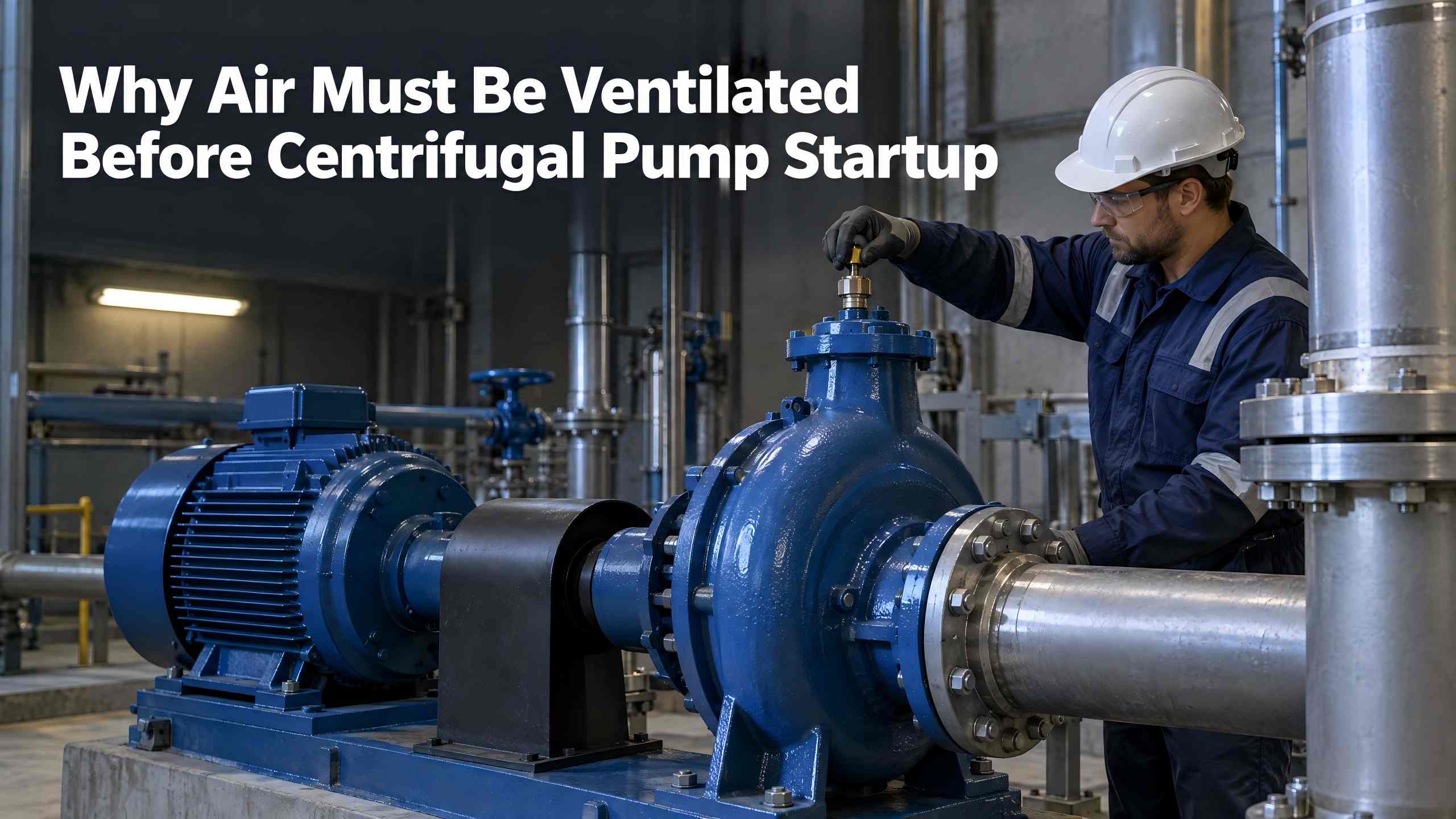
1. Close the pump outlet valve and fully open suction line valves.
2. Slowly fill the pump casing with process medium through the priming port to avoid introducing new bubbles.
3. Open the air‑vent plug or vent valve on top of the pump casing.
4. Keep venting until bubble‑free liquid flows steadily from the vent port.
5. Tighten the air‑vent plug or close the vent valve.
6. Start the pump set, slowly open the outlet valve, and monitor pressure and vibration.
Note: For long suction pipelines, air tends to accumulate at pipe high points. Vent these raised sections separately in addition to venting the pump body; do not only vent the pump casing.
Air Binding Persists After Venting? Troubleshooting Checklist
If air binding still occurs after following venting steps, root causes usually lie in system leakage or installation rather than improper venting. Conduct item‑by‑item checks as below:
Phenomenon
Probable Cause
Remedy
Continuous gas discharge with no liquid at the vent port
Leaks in suction pipes, flanges or seals
Locate leaks section by section; fasten or replace seals
Pump chamber drains quickly after priming
Failed foot valve or pipeline siphon backflow
Inspect foot valve; install vacuum holding tank
Air pockets only at high points while lower sections function normally
Absence of high‑point vents for long pipelines
Install vent valves at raised pipe sections
Air binding on self‑priming pumps
Excessive accumulated gas or insufficient priming water inside chamber
Perform manual priming and venting before startup
Post this checklist on startup inspection sheets to eliminate most misdiagnoses.
Frequently Asked Questions
Must priming and air venting be performed for every centrifugal pump startup?
Priming and venting are recommended for most operating conditions. After shutdown, air seeps gradually into pump casings through seals and pipeline gaps, creating air‑binding hazards upon restart. Manual priming may be largely omitted only for pumps installed below tank liquid level with well‑sealed pipelines. Even then, confirm no trapped air before startup.
Are air binding and cavitation the same fault?
No, they must not be confused. Air binding arises from massive gas entrainment inside the pump that prevents vacuum build‑up, resulting in complete loss of liquid suction. It is resolved by priming and venting. Cavitation occurs when liquid vaporises into bubbles in low‑pressure zones; bubble implosion erodes impeller metal, causing pitting corrosion, vibration and abnormal noise. It is addressed by improving suction conditions (e.g. increasing available net positive suction head NPSHa). The two differ in root causes, symptoms and corrective measures.
Summary
In short, incompressible liquid enables vacuum generation during impeller rotation; compressible trapped gas inside pumps triggers air binding and loss of suction capacity. Priming and air venting before centrifugal pump startup remove gas from pump chambers to establish effective vacuum and protect pump sets from damage due to dry running. Incorporate priming and air venting into startup inspection checklists as baseline procedures for long‑term stable operation.
Should you encounter questions regarding centrifugal pump selection, on‑site commissioning or fault diagnosis, please contact Teffiko engineering team. Targeted technical support will be offered based on your medium properties and operating & installation conditions.【Contact Us】
We use cookies to offer you a better browsing experience, analyze site traffic and personalize content. By using this site, you agree to our use of cookies. Privacy Policy