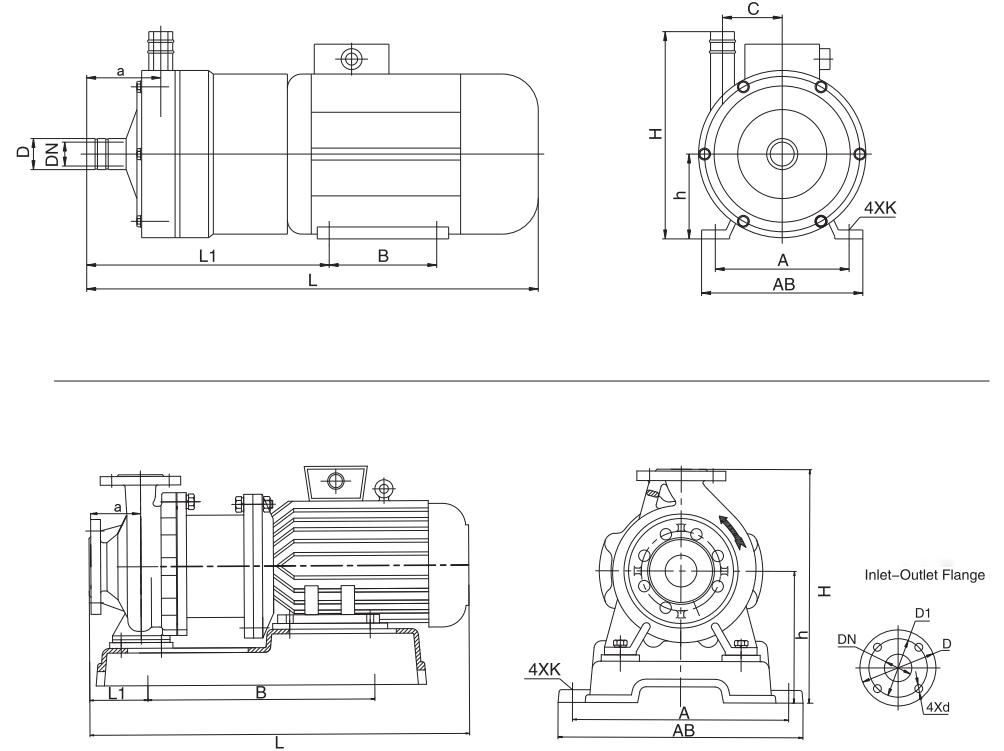
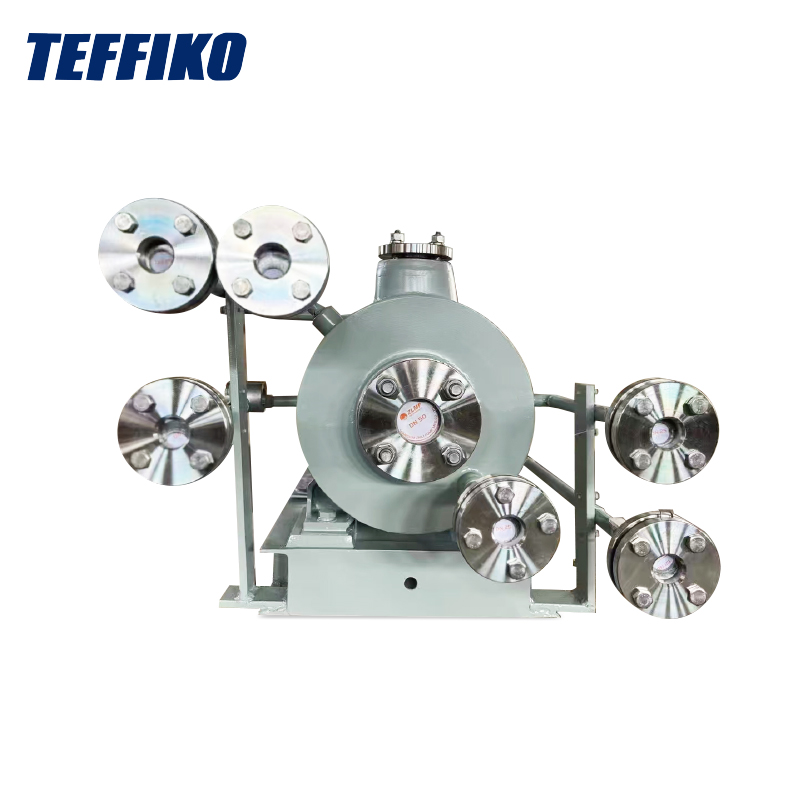
Fluoroplastic magnetic pumps transmit power via magnetic couplings, achieving complete hermetic sealing with zero leakage. When the motor drives the outer magnetic steel of the magnetic coupling to rotate, magnetic lines of force pass through the gap and isolation sleeve to act on the inner magnetic steel, enabling the pump rotor to rotate synchronously with the motor and transmit torque without mechanical contact. Since the liquid is enclosed within the isolation sleeve, material leakage is completely eliminated, reducing pollution, saving energy, purifying the environment, and protecting the physical and mental health of on-site workers.
1.The pump inner lining, impeller inner rotor, and isolation sleeve are all integrally molded from pure F46 material without impurity precipitation, making them highly suitable for transferring high-purity and highly corrosive chemical liquids.
2.The pump casing is made of ductile iron, designed in accordance with national standard flanges. It boasts excellent mechanical strength and can withstand heavy pipeline loads.
3.The flow-through components are lined with F46 material, featuring smooth flow channels, superior hydraulic performance, low hydraulic friction loss, and high efficiency.
4.The pump shaft, bearing sleeve, and dynamic/static rings are all made of pressureless sintered silicon carbide, which exhibits high hardness, high wear resistance, and high corrosion resistance.
5.The unique spiral groove design inside the bearing sleeve facilitates lubrication of the sliding bearing pair and efficiently dissipates heat generated by friction during pump operation.
6.A reinforcing cover made of imported carbon fiber material is added outside the isolation sleeve, allowing the pump unit to withstand higher system pressure and eliminating heat generated by magnetic eddy currents in metal sleeves.
7.The inner and outer magnets are made of neodymium-iron-boron material, with a surface magnetic flux density of up to 3600 Gauss. This enables smooth transmission of the prime mover’s torque to the impeller without slipping even under high-flow conditions, preventing contact between the impeller inner rotor and the rear thrust ring. This avoids melting of fluoroplastic components due to frictional heat, ensuring stable operation of the magnetic pump in highly corrosive environments.
8.The entire pump unit adopts a back-pull structure, allowing a single person to perform internal maintenance and part replacement without disassembling the pipeline, ensuring convenient maintenance.
Installation and Commissioning Specifications for Fluorine-Lined Magnetic Pumps
1.Magnetic pumps should be installed horizontally and not vertically. For special occasions requiring vertical installation, the motor must face upward.
2.When the suction liquid level is higher than the pump shaft centerline, simply open the suction pipe valve before startup. If the suction liquid level is lower than the pump shaft centerline, a foot valve must be installed in the pipeline.
3.Before starting the pump, conduct inspections: the motor fan blades should rotate flexibly without jamming or abnormal noise; all fasteners must be securely tightened.
4.Verify that the motor rotation direction matches the rotation mark on the magnetic pump.
5.After starting the motor, slowly open the discharge valve. Once the pump enters a stable operating state, adjust the discharge valve to the required opening.
6.Before stopping the pump, close the discharge valve first, then cut off the power supply.
Precautions for Using Fluoroplastic Magnetic Pumps
Here are some tips for using magnetic pumps. Understanding them will help ensure their safer and more efficient operation:
For example, the bearings of the pump rely entirely on the conveyed medium for cooling and lubrication. So, dry running is strictly prohibited. Also, avoid no-load operation when restarting after a power outage during operation, otherwise, the components may be easily damaged.
If there are solid particles in the conveyed medium, remember to install a filter screen at the pump inlet. If there are ferrous particles, a magnetic filter must be equipped to prevent the pump body from being damaged by impurities.
The ambient temperature during use should not exceed 40°C, and the motor temperature rise should not exceed 75°C, otherwise, it may affect the service life.
In addition, the conveyed medium and its temperature must meet the material requirements of the pump. Generally speaking, it is suitable for conveying liquids with a temperature below 100°C, free of hard particles and fibers. The maximum system working pressure should not exceed 1.0 MPa, the liquid density should not be greater than 1300 kg/m³, and the viscosity should not be greater than 30 cm²/s. For special cases, specific agreements must be followed.
If the conveyed liquid is prone to precipitation and crystallization, be sure to clean the pump body in time after use and drain all the accumulated liquid inside to avoid blockage.
After 1000 hours of normal operation, it is better to check the wear of the bearings and the end-face dynamic rings. Do not make do with worn vulnerable parts; timely replacement is necessary to ensure performance.
One more reminder: The magnetic coupling in the magnetic pump uses high-performance permanent magnet materials, which may affect some sensitive devices, such as pacemakers, magnetic cards, mobile phones, and watches. Remember to keep a certain distance from them.
Finally, the power supply voltage should be stable and not too high. For pumps with a power of more than 18.5 kW, it is recommended to install a frequency conversion device or an auto-transformer step-down device, which can better protect the motor.
Faults and Troubleshooting Methods
Fault Type
Causes
Troubleshooting Methods
No water discharge
1. Reverse pump rotation2. Air leakage in the suction pipe3. Insufficient water in the pump chamber4. Excessively high voltage causing coupling slippage during startup5. Excessively high suction lift6. Valve not opened
1. Adjust motor wiring2. Eliminate air leakage3. Increase water volume in the pump chamber4. Correct the voltage5. Lower the pump installation position6. Repair or replace the valve
Insufficient flow
1. Too small or clogged suction pipe diameter2. Blocked impeller flow channel3. Excessively high head4. Impeller wear
1. Replace or clean the suction pipe2. Clean the impeller3. Open the water valve wider4. Replace the impeller
Low head
1. Excessively high flow2. Too low rotation speed
1. Reduce the opening of the discharge valve2. Restore the rated rotation speed
Excessive noise
1. Severe shaft wear2. Severe bearing wear3. Contact between outer/inner magnetic steel and isolation sleeve4. Sealing ring and impeller grinding against each other5. Unstable pipeline support6. Cavitation
1. Replace the bearing2. Replace the shaft3. Dismantle and reassemble the pump head4. Replace the thrust ring and sealing ring5. Stabilize the pipeline6. Reduce the vacuum degree
Liquid leakage
Damaged O-ring
Replace the O-ring
Teffiko: An Italian Craftsmanship Choice in the Fluoroplastic Magnetic Pump Field
In the selection and application of fluoroplastic magnetic pumps, choosing a brand with strong technical capabilities, reliable quality, and industry experience is crucial for ensuring safe and efficient production. Teffiko, an Italian brand, is a trustworthy choice in this field. Whether you need stable output under standard working conditions or customized solutions for special media, Teffiko can provide reliable support with its professional products and services, making it an excellent partner for fluoroplastic magnetic pump applications in industrial production.
We use cookies to offer you a better browsing experience, analyze site traffic and personalize content. By using this site, you agree to our use of cookies.
Privacy Policy