Athena Engineering S.r.l.
News

Working Principle of API PLAN 53B Flush Plan

2026-06-15 0 Leave me a message

API PLAN 53B flush plan is a mainstream barrier fluid circulation and pressurization system for zero-leakage seals under working conditions with high-pressure, toxic and flammable media, which strictly complies with the API 682 industry standard. Many pump manufacturers and operation & maintenance engineers fail to distinguish the pressurization logic of Plan 53A, 53B and 53C. This document fully explains the working principle of API PLAN 53B flush plan.

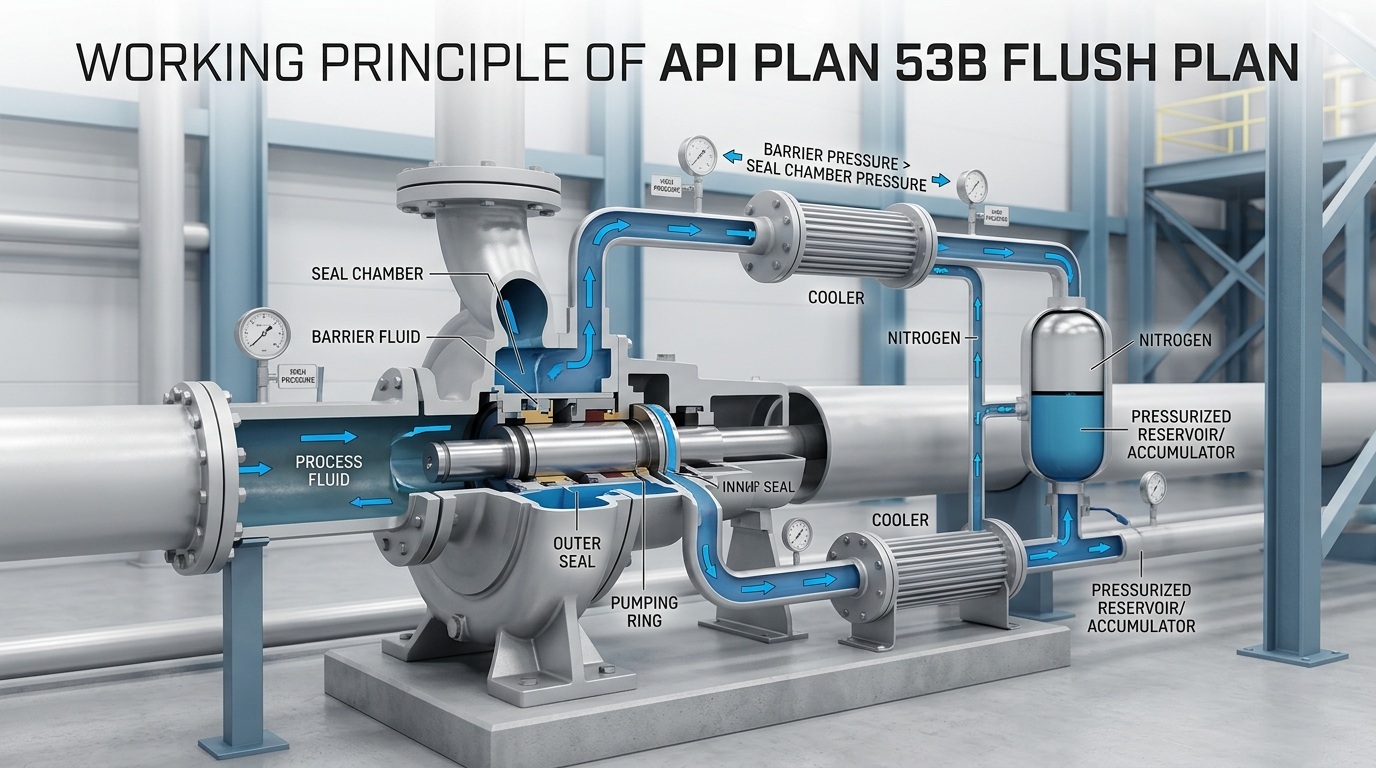
API Plan 53B schematic

Core Working Principle of API PLAN 53B Flush Plan

Combined with the entire cycle of equipment startup, shutdown and operation, the working principle of API PLAN 53B flush plan can be accurately divided into three core stages: pressure establishment, circulating cooling, leakage compensation and monitoring. The whole process operates in a closed-loop and automatic manner with excellent stability.

1. Pressure Establishment Stage

Before system startup, pre-charge inert gas into the bladder gas chamber through the dedicated charging port of the accumulator to complete system pressure calibration. The overall pressure of the barrier fluid is strictly controlled to be 2~6 kg/cm² higher than the pressure of the process medium in the pump seal chamber, so as to form a reliable pressure barrier. Relying on the elastic buffering characteristic of the bladder, the system can maintain stable pressure for a short time even with minor loss of barrier fluid, preventing seal failure caused by sudden pressure drop and laying a solid safety foundation for equipment startup and operation.

2. Circulating Cooling Stage

After the pump is started, the built-in pumping ring drives the barrier fluid to circulate. The low-temperature and high-pressure barrier fluid lubricates the seal friction pairs while carrying away heat. The heated barrier fluid flows through the heat exchanger for cooling, and then returns to the seal chamber to form a closed loop. This controllable temperature and pressure environment effectively prevents high-temperature wear, dry burning and coking on the seal faces, and greatly extends the service life of mechanical seals.

3. Leakage Compensation and Monitoring Stage

During normal equipment operation, minor loss of barrier fluid will inevitably occur as a small amount of barrier fluid permeates into the process medium side through the inner seal face, which is a normal phenomenon. At this time, the high-pressure nitrogen inside the accumulator bladder expands automatically under the pressure difference, pushing the barrier fluid in the liquid chamber to replenish the circulation circuit, so as to compensate for fluid loss and stabilize the system pressure in real time without manual intervention.

If the seal wear intensifies or slight pipeline leakage occurs, the excessive loss of barrier fluid will cause the system pressure to drop below the set threshold, and the matched pressure switch will trigger an alarm automatically. Operation and maintenance personnel can replenish clean and compatible barrier fluid through the fluid replenishing port to quickly restore the rated system pressure and ensure the continuous and safe operation of the equipment.

Key Notes for Daily Operation and Maintenance

Standardized operation and maintenance are essential for the long-term stable operation of the 53B system. The following key points shall be focused on in daily work:


  • A compatibility test shall be conducted between the barrier fluid and process medium in advance to avoid material contamination, scaling or corrosion caused by internal permeation.
  • Regularly inspect the pre-charge nitrogen pressure of the accumulator. Supplement nitrogen in a timely manner if pressure decays, and replace the bladder immediately once it ages or is damaged.
  • Completely vent air from all pipelines before equipment startup to avoid circulation interruption due to air blockage, which may lead to dry friction and burnout of seals.
  • Regularly clean scale and oil stains on the heat exchanger to ensure heat dissipation efficiency and prevent failure of the barrier fluid caused by excessive temperature.
  • It is recommended to connect the pressure alarm system to the DCS control system to realize automatic low-pressure early warning and prevent further expansion of equipment faults.


Summary

In short, the core of API PLAN 53B flush plan lies in the independent pressure stabilization by the bladder accumulator combined with the three-stage closed-loop system for circulating cooling and compensation. It fully protects double mechanical seals by establishing a pressure barrier through pre-pressurization, implementing forced cooling via the pumping ring, and achieving automatic pressure compensation and stabilization with the accumulator.

For more industry knowledge and selection skills of mechanical seal flush plans, Teffiko is deeply engaged in industrial fluid equipment sectors including petroleum & chemical industry, coal chemical industry and fine chemical industry. We focus on sharing professional and practical technologies as well as engineering selection experience of pumps, valves and seals, helping engineering and technical personnel select optimal solutions for actual working conditions.


Related News
Leave me a message
  • BACK TO ATHENA GROUP
  • X
    We use cookies to offer you a better browsing experience, analyze site traffic and personalize content. By using this site, you agree to our use of cookies.Privacy Policy
    RejectAccept