Athena Engineering S.r.l.
News

Differences Between Rotary Lobe Pumps and Screw Pumps

2026-06-08 0 Leave me a message

This article summarizes the core differences between the two types of pumps in an all-round manner. The content is presented in an easy-to-understand way to accurately meet various industrial production needs and help you quickly solve pump selection problems.

Differences in Self-priming Capacity and Dry Running Performance

Self-priming capacity and dry running stability are key performance indicators for continuous industrial production, as well as one of the most essential distinctions between rotary lobe pumps and screw pumps. They directly affect equipment fault tolerance and production stability.

1. Advantages of Rotary Lobe Pumps in Self-priming and Dry Running

The self-priming performance of rotary lobe pumps is regulated by rotational speed, delivering strong adaptability to working conditions. A stable and efficient self-priming effect can be achieved when the rotational speed exceeds 200 rpm. In addition, rotary lobe pumps feature excellent dry running performance. They can operate continuously under dry conditions for more than half an hour with a gentle temperature rise during operation. No component burnout or structural damage will occur, resulting in high production fault tolerance. They are ideal for intermittent operation and working scenarios with material supply interruptions.

2. Limitations of Screw Pumps in Self-priming and Dry Running

Screw pumps also deliver sound self-priming capacity that can meet conventional negative pressure feeding requirements. However, they are extremely sensitive to dry running, which is their biggest operational limitation. Long-term dry running is strictly prohibited for screw pumps, and idle operation without medium must not last more than 30 seconds. Dry running for just a few minutes will cause a sharp internal temperature increase, leading to wear and burnout of precision components such as stators and screws. This will result in equipment malfunctions and unplanned downtime, severely disrupting continuous production lines.

Differences in Equipment Size and Installation Space

Floor area and installation flexibility are important selection criteria for factory layout, equipment renovation and deployment in narrow workshops. The two pump types differ greatly in space adaptability.

1. Rotary Lobe Pumps: Compact Size and Customization Support

Rotary lobe pumps adopt an exquisite and compact overall design with a small footprint, imposing minimal requirements on installation space. They are applicable to confined workshops and side mounting on production lines and other space-limited scenarios. Meanwhile, customized solutions are available for rotary lobe pumps. Special calibers and dimensions can be tailored to match different flow rates and pipeline connection requirements, offering outstanding versatility.

2. Screw Pumps: Bulky Structure and Fixed Specifications

Taking commonly used single screw pumps as an example, their long screw bodies make the whole unit bulky and require ample installation space. Furthermore, screw pumps feature relatively fixed specifications with non-adjustable dimensions, making it difficult to adapt to special pipelines and renovated working conditions. Adequate operating space is also required for subsequent equipment maintenance, so maintenance work cannot be carried out conveniently in space-constrained workshops.

Differences in Structural Principles and Operating Conditions for Fluid Conveying

Distinct structural designs lead to fundamental differences in conveyed media, operating pressure and applicable scenarios, which serve as the core basis for pump selection.

1. Structure and Operating Conditions of Rotary Lobe Pumps

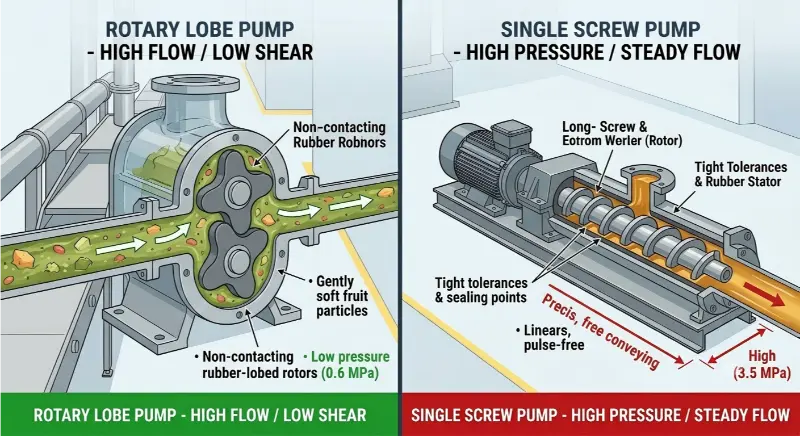
The core components of a rotary lobe pump include a pair of special-shaped rotors, pump casing, sealing assemblies and reduction gearbox. The rotors rotate without contacting each other and maintain a tiny clearance. The flow passage is wide and free of intricate clog-prone structures. These pumps are mainly designed for low-pressure and large-flow conveying, with good resistance to particulate matter and low shearing force. Their standard operating pressure ranges from 0.3 MPa to 1.6 MPa. They are suitable for conveying media containing solid particles, high-viscosity materials and substances vulnerable to shear damage, such as jam, meat paste, sludge slurry and chemical materials with particles. They effectively prevent material clogging and preserve the original properties of conveyed media.

2. Structure and Operating Conditions of Screw Pumps

Screw pumps form sealed conveying cavities through precisely meshed single or multiple screws and rubber stators. They boast much higher machining precision and superior cavity tightness compared with rotary lobe pumps. These pumps excel at high-pressure conveying with stable and pulse-free delivery. The maximum working pressure of single screw pumps can reach 4.0 MPa, while triple screw pumps are capable of medium and high-pressure boosting. They are more suitable for conveying homogeneous viscous media free of large hard particles, such as crude oil, lubricating oil, syrup and chemical resin, and ensure superior continuity and stability during conveying.

Rotary lobe and screw pumps

Comparison of Maintenance Methods, Spare Parts Costs and Service Life

Operation and maintenance costs are major considerations for long-term factory production. The two pump types differ remarkably in maintenance difficulty, spare parts prices and service life, which directly affect enterprises' production costs.

1. Rotary Lobe Pumps: Simple Maintenance and High Cost Performance

Featuring a simple structure and modular design, rotary lobe pumps have a low maintenance threshold. On-site disassembly and repair can be performed directly when faults occur, with no need to remove the entire unit or use large auxiliary equipment. They have few vulnerable parts, among which the mechanical seal is the main consumable component. Worn wear-resistant coatings on rotors can be partially repaired instead of full replacement. In addition, spare parts for rotary lobe pumps are affordable, resulting in low procurement costs. They deliver excellent long-term operation and maintenance cost performance, making them a great choice for small and medium-sized factories and high-frequency continuous production.

2. Screw Pumps: Complicated Maintenance and High Long-term Costs

Screw pumps have sophisticated internal structures with highly matched screws and stators. Troubleshooting and repair procedures are complicated, requiring professional technicians. Rubber stators are frequently worn parts, which are prone to damage even when exposed to slightly hard particulate matter and need regular replacement. Meanwhile, precision screw components come with higher procurement prices. Combined with time-consuming maintenance and high downtime costs, the overall long-term operation and maintenance costs of screw pumps are far higher than those of rotary lobe pumps.

Ultimate Selection Guide: How to Make the Optimal Choice

Based on all the differences between the two pump types, you can select the proper pump according to actual production scenarios:

Choose Rotary Lobe Pumps Preferentially If:

Your workshop has limited space, customized equipment is required, intermittent material supply interruption may occur on the production line, you need to convey particulate media or materials sensitive to shear force, or you intend to cut down long-term operation and maintenance costs.

Applicable industries: Food processing, municipal sludge treatment, kitchen waste disposal and conventional chemical slurry conveying.

Choose Screw Pumps Preferentially If:

Sufficient installation space is available, the conveyed media is homogeneous and free of large particles, high-pressure and stable conveying is required, and maximum conveying smoothness is pursued.

Applicable industries: Crude oil transportation, lubricating oil delivery, conveying of high-viscosity chemical stock solutions and pressure boosting of precision materials.

For professional pump equipment, trust Teffiko. Backed by mature technologies and a comprehensive service system, we provide reliable fluid conveying solutions for various industries. To learn more about product details and technical parameters, please visit: www.teffiko.com


Related News
Leave me a message
  • BACK TO ATHENA GROUP
  • X
    We use cookies to offer you a better browsing experience, analyze site traffic and personalize content. By using this site, you agree to our use of cookies. Privacy Policy
    Reject Accept