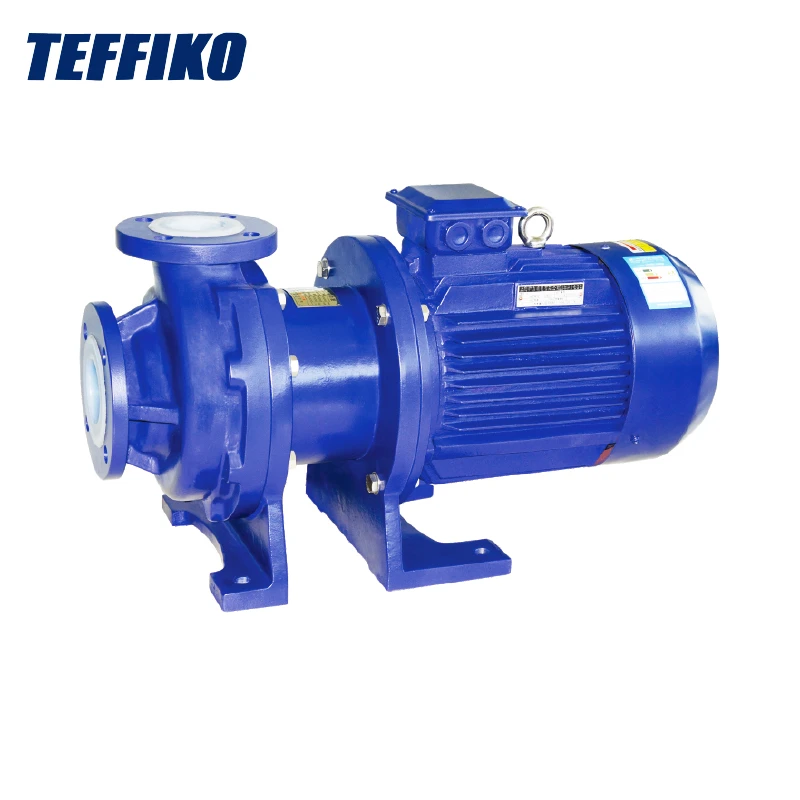
Magnetic drive pumps rely on the process fluid to lubricate and cool their bearings. Once operating conditions drift outside design limits, damage can occur within minutes. Through long-term service to chemical and petrochemical customers, Teffiko has found that most failures are not quality problems, but violations of operating boundaries. The eight golden rules below explain the underlying principles; followed strictly, they prevent more than 95% of abnormal failures.
Rule 1: Never Run in Reverse
Motor rotation must match the direction marked on the pump nameplate. Reverse rotation delivers no flow and can damage the impeller and coupling; in severe cases it can burn out the motor. After new installation or maintenance rewiring, always jog the motor to confirm rotation before putting the pump into continuous service.
Key insight: Reverse rotation forces both the motor and the hydraulic components backward at the same time; verifying rotation is a mandatory safety check after installation.
Rule 2: Never Dead-Head for Long Periods
With discharge flow near zero, the impeller keeps spinning and consuming power. That energy produces no fluid delivery — it all turns into heat. The fluid inside vaporizes, bearing temperature keeps rising, and friction between the rotor and containment shell generates heat that ultimately leads to high-temperature demagnetization.
A momentary closed discharge valve at startup is acceptable, but prolonged dead-heading must be avoided. When process flow falls below the minimum continuous flow rate, install a bypass recirculation line rather than forcing pressure by throttling the discharge valve.
Key insight: Dead-heading essentially turns a transfer pump into a heating resistor; the heat cannot escape, so the system keeps storing heat.
Rule 3: Avoid Thermal Shock
Heating and cooling rates should generally not exceed 10°C per minute. Cold pumps suddenly fed hot liquid, or hot pumps suddenly fed cold water, cause uneven thermal expansion and contraction of the containment shell and plastic parts, leading to cracking, deformation, and loosened magnet assemblies. Change operating conditions with gradual ramp-up and ramp-down.
Key insight: Thermal shock is "temperature difference fighting inside the parts" — buy safety with time.
Rule 4: No Dry Running
Once a magnetic pump runs dry, the sleeve bearings immediately lose lubrication at high speed and wear accelerates manyfold. At the same time, the inner magnet rotor cutting the magnetic field generates eddy-current heat that keeps accumulating; once the magnets exceed their temperature limit, permanent demagnetization sets in and the magnetic field can never be restored.
Some manufacturers advertise "dry-run capability," but under strict conditions: it tolerates only short periods, typically no more than 3–5 minutes unloaded, and must never be treated as normal operation. Install a low-flow switch or underload protection to shut down automatically on loss of fluid.
Key insight: Dry running does not simply "break the bearings first" — it collapses lubrication, cooling, and the magnetic field all at once, which is why it destroys the pump the fastest.
Rule 5: Prime Before Starting
Before every startup, the pump chamber must be fully filled with liquid and all air purged. Residual air pockets break the lubrication film, cause abnormal noise, and can trigger direct dry friction. Open the suction valve first, fill the pump, and vent repeatedly; confirm the chamber is full before energizing.
Key insight: Priming is not a ritual — it lays down the first lubrication film on the bearings.
Rule 6: Prevent Cavitation
Carelessly modified piping, changing tank levels, or unstable fluid temperature all alter the net positive suction head available (NPSHa). When suction pressure is insufficient, liquid vaporizes inside the pump; bubbles violently collapse when entering the high-pressure zone, repeatedly attacking the impeller and flow passages. Cavitation does not wear the pump gradually — it can scrap the whole pump in a short time, accompanied by gravel-like noise.
During operation, keep the suction side fully flooded, minimize bends and blockages in piping, and maintain an NPSHa margin above the required NPSHr.
Key insight: What makes cavitation frightening is that "the liquid keeps boiling and exploding inside the pump"; the damage target is the metal wetted parts, not the bearings.
Rule 7: Never Exceed Rated Temperature
Continuously monitor process fluid temperature during operation; it must not exceed the nameplate rating. Excess heat weakens the magnetic field, softens plastic components, and accelerates bearing aging. Note especially: even with cool incoming fluid, prolonged low-flow dead-heading builds up heat inside the pump on its own — a point often overlooked.
Key insight: The rated temperature protects not just the fluid, but the magnetic strength of the magnets.
Rule 8: No Prolonged Operation at Extreme Flow Rates
Magnetic pumps must run within the design flow range. Long-term deviation from the best efficiency point — whether flow is too low or too high — raises bearing load, increases vibration, and unbalances the rotor. Select the pump to match real operating conditions during sizing; do not let it run outside the performance curve long term.
Key insight: Sizing sets the boundary, operation determines service life; running beyond the curve draws down the design margin in advance.
Behind the Eight Rules Lies One Common Thread
Taken separately, the prohibitions differ; taken together, they all point to a single principle:
The fluid must continuously lubricate the bearings and carry away heat, and the magnets must always stay below their temperature limit. Dry running cuts off lubrication; dead-heading stores heat; cavitation attacks metal; over-temperature demagnetizes; thermal shock cracks the shell; air binding and reverse rotation are human errors on the operating side.
Understand this thread and you need not memorize the eight rules by rote: any practice that stops the fluid from circulating, traps heat, or overheats the magnetic field must be stopped.
Conclusion
Trouble-free magnetic pump operation is not luck — it is respect for the underlying principles. Keep these eight: verify rotation, never dead-head, avoid thermal shock, do not dry-run, prime and vent, prevent cavitation, control temperature, and stay within flow limits. Only then will a magnetic pump run smoothly and quietly for the long term.
We use cookies to offer you a better browsing experience, analyze site traffic and personalize content. By using this site, you agree to our use of cookies. Privacy Policy