Athena Engineering S.r.l.
News

API 610 Pump Type Selection Matrix: How to Choose Between OH1–OH6 and BB1–BB5

2026-11-09 0 Leave me a message

Every API 610 pump datasheet begins with two letters and a number: OH2, BB5, VS6. That short code decides how the pump is mounted, how the rotor is dismantled, how much pressure the casing can contain, and how the machine behaves when the plant runs hot. Choose it wrong, and no amount of hydraulic optimization afterward will fix the installation.

This guide lays out the full type matrix and, more importantly, the decision path from duty data to the right code. Teffiko manufactures API-type centrifugal pumps across the OH and BB ranges for chemical, thermal power and refining services, and this is the framework our engineering team applies when a customer sends operating data for review.


What API 610 Covers, and When It Applies

API 610, Centrifugal Pumps for Petroleum, Petrochemical and Natural Gas Industries, is published by the American Petroleum Institute. The first edition appeared in 1954, and the standard is revised on a roughly five-year cycle. The Thirteenth Edition was released in June 2026 and is the current version, replacing the Twelfth Edition (January 2021).

The standard applies to new centrifugal pumps, including pumps running in reverse as hydraulic power recovery turbines, in petroleum, petrochemical and gas industry process services. API notes that pumps produced to this standard are cost-effective when liquid conditions exceed any one of the following thresholds:

  •  discharge pressure above 275 psi (19 bar) gauge
  •  suction pressure above 75 psi (5 bar) gauge
  •  pumping temperature above 300 °F (150 °C)
  •  rotational speed above 3,600 rpm
  •  rated total head above 400 ft (120 m)
  •  impeller diameter above 13 in (330 mm) for overhung pumps

Two things the standard deliberately does not do: it does not select your hydraulics, and it does not rank the types against each other. The type code describes mechanical arrangement only. Two pumps carrying the same code can have completely different curves, efficiencies and materials of construction. The certified performance curve and the completed datasheet, not the type code, define what a pump will actually deliver on site.

The OH Family: Six Overhung Configurations (OH1 to OH6)

Overhung (OH) pumps mount the impeller on the end of the shaft, cantilevered out from a single bearing housing on the drive side. All radial and axial hydraulic loads pass back through the shaft into that one bearing frame. The arrangement is compact and the rotor withdraws without disturbing the casing, but shaft deflection at the seal is the design limit that keeps OH pumps in the moderate-duty range.


Type Configuration Where it fits
OH1 Horizontal, foot-mounted, single-stage; separate baseplate, flexible coupling General transfer of clean to mildly corrosive liquids at moderate temperature and pressure, where frequent seal and bearing access matters
OH2 Horizontal, centerline-mounted, single-stage; single bearing housing, flexible coupling The default hydrocarbon process pump; tolerates thermal expansion without pipe strain; hot oil and thermal fluid service
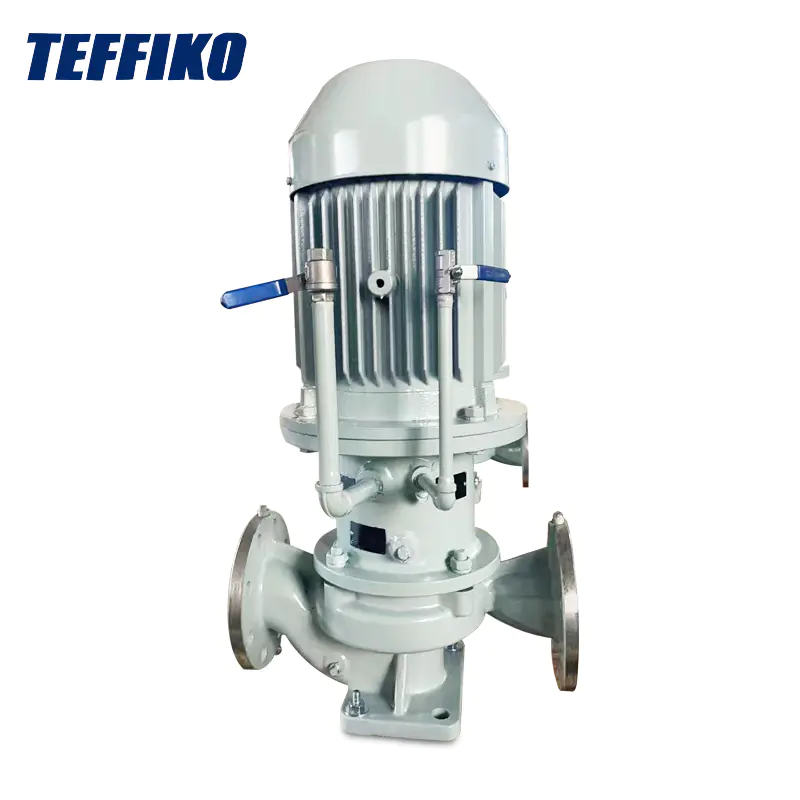
OH3 Vertical, in-line, single-stage; separate bearing bracket, flexible coupling In-line pipeline service where floor space is limited
OH4 Vertical, in-line, single-stage; rigid coupling to the driver Compact in-line installations with short rotors and low-risk service
OH5 Vertical, in-line, single-stage; close-coupled, impeller mounted on the motor shaft The most compact OH arrangement; low-pressure, clean-media transfer
OH6 Single-stage overhung with an integral speed-increasing gearbox; horizontal or vertical Low-flow, high-head duties where a gear stage buys head without adding rotor stages


OH1 and OH2 are the two configurations you will meet most often, and the difference is mounting. OH1 sits on casing feet; OH2 is supported at the shaft centerline. That distinction is not cosmetic. When a foot-mounted casing grows thermally, the expansion works against the piping and the alignment; a centerline-mounted casing grows around the shaft axis and leaves the driver alignment intact. This is why OH2 is the standard choice for high-temperature hydrocarbon service, and why OH1 stays in general-duty transfer. The details of the two mountings are compared in OH1 vs OH2 centrifugal pumps and in our analysis of OH2 structure and operating principle and centerline mounting.

OH3 to OH5 form the vertical in-line branch: the pump hangs in the pipeline, the motor sits above it, and the baseplate disappears. OH3 keeps a separate bearing bracket and a flexible coupling, OH4 replaces the flexible coupling with a rigid one, and OH5 mounts the impeller directly on an extended motor shaft. Each step down that list buys compactness and gives up maintainability, which is why the choice between OH3 and OH4 is really a choice about how often the seal will be touched. OH3 also has a dedicated place in chemical process duty; see the OH3 vertical chemical process pump.

OH6 is the specialist of the family. An integral speed-increasing gearbox between motor and impeller delivers the peripheral speed a single stage needs for very high head at low flow, without the rotor length of a multistage machine. It appears in high-pressure feed and booster service; see what an OH6 pump is.

One caution for critical-service datasheets: the standard's type table has historically flagged OH1, OH4 and OH5 as configurations that do not satisfy every requirement of the standard, which is why they are normally reserved for less critical duties. Confirm the status of that note in the edition you are specifying before writing these types into a critical-service specification.

Teffiko's OH-range product pages cover the horizontal and vertical in-line configurations: OH1 overhung horizontal pumps, OH2 overhung horizontal pumps, OH3 vertical chemical process pumps and OH4 pumps in horizontal and vertical arrangements.

The BB Family: Five Between-Bearings Configurations (BB1 to BB5)

Between-bearings (BB) pumps support the rotor with bearing housings on both sides of the impeller group. Shaft deflection drops dramatically, casings can be built for far higher pressures, and multistage arrangements become practical. The price is a longer machine that needs more dismantling space and a heavier baseplate.


Type Casing split Stages Where it fits
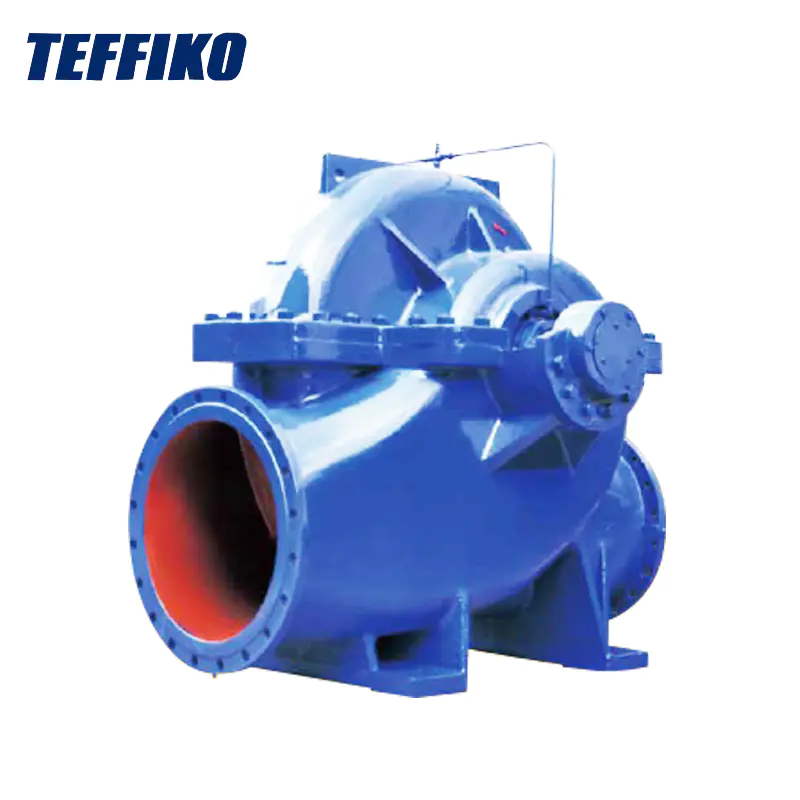
BB1 Axially split (joint along the shaft axis) One or two The largest flows at moderate pressure; the rotor lifts out of the top half without disturbing piping
BB2 Radially split One or two Single- and two-stage high-pressure service with better pressure containment than BB1
BB3 Axially split Multistage High head at moderate pressure where overhaul access matters
BB4 Radially split, single casing (ring-section) Multistage High head in a compact footprint; stage segments clamped by tie rods
BB5 Radially split, double casing (barrel) Multistage The pressure ceiling of the family: hydrocracking, high-pressure injection, boiler feed


BB1 is the workhorse for volume. The axially split casing lifts open for rotor access, and a double-suction first stage balances axial thrust, which is why large cooling-water and crude-transfer duties land here; see API 610 pumps for crude oil transfer. BB2 keeps the one- or two-stage rotor but moves to a radially split casing when the pressure boundary demands it. The split between BB1 and BB2 is therefore a pressure decision, not a performance one.

BB3, BB4 and BB5 are the multistage tier. BB3 keeps the axially split casing, so the rotor comes out vertically for inspection; BB4 switches to a radially split ring-section casing for a shorter, stiffer machine; BB5 wraps the whole cartridge in an outer pressure barrel. The BB3 versus BB4 comparison is really the maintenance-access versus footprint trade. BB5 deserves one procurement warning: the inner assembly withdraws axially, so the installation must reserve the full length of the pump plus the cartridge, not just the footprint.

Teffiko's between-bearings range is covered by the axially split BB pumps and multistage BB pumps product pages.

The Selection Matrix: From Duty Data to Type Code

The type code follows from four inputs, in this order: total head, stage count, pressure boundary and maintenance access. Run them as a sequence and the candidate list narrows quickly.

1. Head decides the stage count. If one stage at a sensible speed and impeller diameter meets the duty, stay single-stage (OH1, OH2, BB1 or BB2). Multistage designs (BB3 to BB5, or OH6 with a gear stage) only earn their complexity when head demands it.

2. Pressure decides the casing split. Low to moderate pressure favors axially split casings (BB1, BB3) because the rotor lifts out for overhaul. High pressure pushes the design to radially split casings (BB2, BB4, BB5).

3. Temperature decides the OH mounting. Hot service means OH2 centerline support, not OH1 feet. For higher-pressure hot service, the 13th edition's casing key-slot requirements exist precisely to manage thermal growth: above 500 °F for OH2, above 300 °F for BB3, and above 500 °F for BB2 and BB5.

4. Footprint and piping decide horizontal versus vertical in-line. OH3 to OH5 exist for tight layouts where a baseplate does not fit.

5. Energy and suction conditions close the case. High power and speed, low NPSH margin or demanding suction conditions move the design toward between-bearings construction, where the rotor support and the suction stage can be sized independently.


Duty profile Candidate types Why
General liquid transfer, moderate temperature and pressure, frequent maintenance OH1, OH2 Compact, economical, rotor and seal accessible from the drive end
Hot oil, thermal fluid, high-temperature process duty OH2 (centerline) Casing growth does not disturb driver alignment
In-line pipeline booster, limited floor space OH3, OH4, OH5 No baseplate, straight-through piping, motor above
Low flow, very high head, small package OH6 Gear stage delivers head without a multistage rotor
Very large flow at moderate pressure (cooling water, crude transfer) BB1 Axially split casing, double-suction option, easy overhaul
One- or two-stage high-pressure service BB2 Radially split casing for pressure containment
Multistage, moderate pressure, overhaul access matters BB3 Axially split multistage casing
High head in a compact multistage footprint BB4 Ring-section casing, shorter and stiffer than BB3
Ultra-high pressure: hydrocracking, injection, boiler feed BB5 Double-casing barrel contains full pump pressure


The matrix narrows candidates; it does not finish the selection. The final step is the datasheet itself: fill in rated, normal and minimum continuous stable flow, NPSH available against NPSH required, materials class and the seal arrangement, then compare vendors field by field on the same form. Two pumps with the same type code and different curves are not the same pump. For the hydraulics behind the duty figures, our guide to centrifugal pump head calculation and the primer on specific speed cover the numbers the matrix assumes you already have.

OH versus BB: Choosing the Family First

Before the number comes the family. Overhung pumps win on cost, footprint and overhaul simplicity, and they cover the great majority of moderate-duty process services. Between-bearings pumps take over when the rotor gets heavy, the power times speed gets high, the casing must hold real pressure, or the head needs multiple stages. A useful rule of thumb: if the duty can be met by a single-stage machine with acceptable shaft deflection at the seal, stay overhung; the moment you need a multistage rotor or a high-pressure boundary, move between-bearings. The family trade-offs are analyzed in detail in our BB series versus OH series comparison.

What Changed in the API 610 13th Edition (June 2026)

If your specifications cite "the latest edition", they silently changed in June 2026. The 13th edition kept the type-code structure but rewrote large parts of the construction requirements. The changes that matter most to buyers:


  •  Rotordynamics. Sections on rotor dynamics were updated, including torsional vibration analysis, for both standard and specific pump types.
  •  Mechanical seal chambers. Dimensions were added for larger sizes, together with a second table covering high-pressure chambers.
  •  Baseplates. Standard baseplate dimensions previously shown in an informative annex were removed; anchor-bolt requirements moved into the main body of the standard, and details for modular skids were added.
  •  Casings. The pressure-rating basis for pressure-boundary parts was clarified (design by analysis or design by rule), casing joint bolting requirements were updated, and a new mounting-surface tolerance requirement targets soft foot. Suction and discharge flanges must now carry equal ratings, and each pump carries a single pressure rating.
  •  Hydraulics. Rise-to-shutoff now applies to all pumps with a 10 percent minimum, and the NPSHa and NPSHr reference points were clarified, with a default NPSH margin added.
  •  Materials. Inspection requirements were expanded, adding semi-cryogenic service and highly corrosive or erosive duty to higher inspection levels.
  •  JIP 33 commonality. Selected requirements from the JIP 33 procurement specification were incorporated for consistency across API standards.
  •  Hydraulic power recovery turbines. Detailed requirements were added in a dedicated annex.


For a full announcement, see the API publication page for API Standard 610 and the task force's summary of the 13th edition changes.

API 610 versus API 685 versus ASME B73.1

Three standards meet in the centrifugal pump market, and they are not interchangeable. API 610 governs conventional centrifugal pumps with mechanical seals in critical hydrocarbon service. API 685 governs sealless centrifugal pumps, magnetic drive and canned motor; a sealless duty does not belong on an API 610 datasheet, and our complete guide to the API 685 sealless standard covers that scope. ASME B73.1 covers general-purpose horizontal end-suction pumps for less demanding industrial service; see what an ANSI pump is. Writing the wrong standard number into a tender document is one of the most expensive clerical errors in pump procurement.

Five Selection Mistakes That Show Up in Tender Documents

1. Reading the type code as a performance guarantee. The code fixes the arrangement, not the curve. Always evaluate the certified performance data.

2. Specifying OH1, OH4 or OH5 for critical service. These configurations carry the type-table note described above; check it against your edition before committing.

3. Foot-mounting a hot-service pump. If the duty runs hot, OH2 centerline support is the default, not an upgrade.

4. Buying a BB5 without the withdrawal length. Barrel pumps need axial space for cartridge removal, which rarely appears on a footprint-only layout.

5. Citing "latest edition" without a number. Since June 2026 that phrase points to the 13th edition; reviewers will check the changed items against your datasheet.

FAQ

What is the difference between OH and BB pumps in API 610?

OH (overhung) pumps cantilever the impeller from a single bearing housing, which keeps the machine compact and economical for moderate duty. BB (between-bearings) pumps support the rotor between two bearing housings, which cuts shaft deflection and opens the door to higher power, higher pressure and multistage heads. In practice: single-stage moderate duty usually stays overhung; high energy, high pressure or multistage heads move between-bearings.

Which API 610 pump type is best for high-temperature service?

OH2, the centerline-mounted overhung pump. Supporting the casing at the shaft centerline keeps thermal growth from pulling the pump and driver out of alignment, which is why hot oil and thermal fluid duties default to OH2. For higher-pressure hot service, the 13th edition requires casing key slots above 300 °F for BB3 and above 500 °F for BB2 and BB5 to manage the same problem on radially split designs.

Is API 610 the same as ISO 13709?

API 610 has been adopted internationally as ISO 13709. Its 11th edition was published as an identical adoption of ISO 13709:2009, and projects typically cite API 610 in the Americas and ISO 13709 elsewhere. When a tender names one, confirm which edition of the other it maps to before comparing bids.

Which API 610 edition should I specify in 2026?

The Thirteenth Edition, published in June 2026, is current and replaces the 12th edition of January 2021. If your standard specification says "latest edition", it now points to the 13th; review the changed items (seal chamber dimensions, baseplate anchor bolts, casing pressure-rating basis, NPSH margin, rise-to-shutoff) against your datasheet template before issuing it.

Let the Duty Data Pick the Type

The API 610 type matrix is not a popularity contest between OH and BB. Head sets the stage count, pressure sets the casing split, temperature sets the mounting, and access sets the split direction. Work the duty data in that order and the two-letter code falls out on its own; the datasheet and the certified curve then finish the job.

Teffiko manufactures API-type centrifugal pumps across the OH and BB ranges for chemical, thermal power and refining services. If you have flow, head, temperature, pressure and fluid data in hand, send it to the Teffiko engineering team: we will review it against this matrix, recommend the configuration, materials and seal arrangement that fit your service, and provide the full datasheet and performance curves. Visit www.teffiko.com to explore the OH and BB product ranges and download datasheets, or contact us at sales@teffiko.com for selection support and quotations.


Related News
Leave me a message
  • BACK TO ATHENA GROUP
  • X
    We use cookies to offer you a better browsing experience, analyze site traffic and personalize content. By using this site, you agree to our use of cookies. Privacy Policy
    RejectAccept