Athena Engineering S.r.l.
News

Is Venting Mandatory Before Starting a Multistage Pump? Principles of Air Binding and Solutions

2026-11-25 0 Leave me a message

Two viewpoints frequently emerge on-site: one holds that “venting must be performed for every startup”, while the other states “the pump sits below the tank, so it can be started directly”. Both statements are partially correct. To determine the proper procedure, one must first understand why multistage pumps are vulnerable to air.

I. A Multistage Pump Is a Combination of Centrifugal Pumps

Essentially, a multistage pump has multiple impellers assembled in series on a single shaft. Fluid passes sequentially through each stage to gain energy. Its operating principles follow general centrifugal-pump rules: rotating impellers generate centrifugal force, throwing liquid toward the volute and creating a low-pressure zone at the impeller eye. This pressure differential draws incoming liquid.

A critical distinction should be noted: some documents describe “oil-sealed clearances for moving-part sealing with gas-ballast devices” as features of multistage pumps. These actually characterize oil-sealed rotary-vane vacuum pumps. Multistage centrifugal pumps operate neither via oil-sealed clearances nor with gas-ballast devices. Conceptual confusion directly impairs pump selection and maintenance judgements, which merits clarification upfront.

II. How Air Causes Pump Air-Binding

The root cause lies in density difference. Air density is roughly one-thousandth that of water. Work performed by impellers on gas produces only minimal pressure differential, insufficient to deliver adequate flow or maintain sufficiently low pressure at the impeller eye for suction. Consequently, an “air lock” forms inside the pump chamber; liquid cannot be drawn in. This phenomenon is called air-binding.

Typical symptoms of air-binding are easy to identify: the motor runs with a dull sound, no flow occurs at the discharge side, and the pressure gauge fails to reach rated pressure. In this condition, the pump is essentially running dry. It loses pumping capacity despite appearing to operate normally.

Multistage pumps exhibit heightened susceptibility to this issue. With more series-connected stages, suction conditions for the first-stage impeller become critical. If the first stage fails to draw liquid, all downstream stages work against air. Gas accumulates and becomes trapped within diffusers and flow passages across successive stages, making complete venting increasingly difficult. Venting is therefore not merely good practice for multistage pumps — it is mandatory.

III. When Priming May Be Omitted

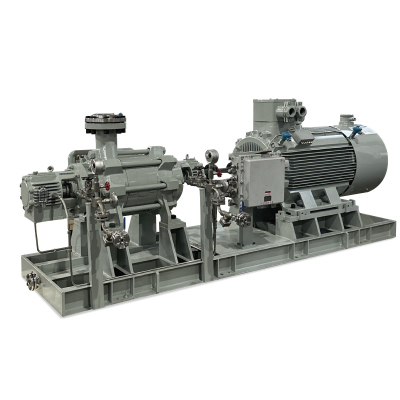
multistage centrifugal pump

A notable reference point: when a pump is installed below the liquid level of a tank, pre-start priming is unnecessary. Gravity drives fluid to fill the pump casing and suction piping automatically.

Conversely, priming and venting are obligatory under suction-lift conditions, where the pump sits above the liquid surface, with no exceptions. Several easily-overlooked scenarios must also be considered:

· Even with flooded suction, air ingestion may occur if liquid level drops near the pump suction nozzle.

· Poor sealing at suction-side flanges, joints or foot valves causes persistent air leakage, making full venting impossible.

· Excessively long suction piping or numerous elbows increase resistance and hinder removal of residual gas.

· When pumping volatile or high-temperature liquids, in-situ vaporisation inside the pump chamber also creates air locks.

Omitting priming depends entirely on installation configuration rather than pump capability. The identical pump may start directly when mounted beneath a tank yet require priming and venting when installed above liquid level.

IV. Consequences of Skipping Venting

1. Dry-run damage to mechanical seals: seal faces lose liquid lubrication and cooling. Temperatures rise rapidly, leading to cracking, leakage or smoking.

2. Cavitation damage to impellers and diffusers: trapped bubbles collapse within high-pressure zones. Repeated collapse causes pitting and honeycomb-type erosion, reducing pump efficiency.

3. Overheating and tripping during dry operation: heat cannot be carried away without flow. Bearings and motor windings overheat, triggering protective shutdowns.

4. Pressure fluctuation and water hammer: two-phase flow causes gauge oscillation and frequent check-valve cycling, imposing shock loads on piping systems.V. Practical Remedial MeasuresVenting addresses symptoms only. Reliable startup requires improvements to the pump and its system:

· Calculate installation elevation: ensure the available net positive suction head (NPSHa) exceeds the pump required net positive suction head (NPSHr). Adopt flooded-suction layout where feasible.

· Optimise suction-side layout: shorten suction piping, reduce elbow count, install foot valves and add vent ports at high points of suction lines.

· Utilise pump structural features: select models equipped with high-point vent plugs and ventable mechanical-seal chambers. For vertical multistage pumps, verify seal-chamber liquid supply arrangements.

· Add priming support: implement vacuum-assisted priming, twin-pump parallel arrangements or liquid-level interlocks. Ensure pump-casing fullness is guaranteed by system design rather than operator memory.

VI. Standard Pre-start Venting Procedure

1. Close the discharge valve and open the suction valve to fill the pump casing with liquid.

2. Slowly open the high-point vent plug on the pump body or the seal-chamber vent valve.

3. Continue venting while gas-liquid mixture with bubbles discharges. Close the vent only once steady bubble-free liquid flow emerges.

4. Jog the motor to verify rotation direction. Reverse rotation severely damages impellers and seals in multistage pumps.

5. Start the pump and gradually open the discharge valve to reach operating conditions.

6. Monitor pressure, electric current, vibration and noise. Shut down immediately for troubleshooting if any parameter deviates abnormally.

VII. Frequently Asked Questions

How long should venting last?

Judge by discharge condition instead of elapsed time. Completion occurs upon continuous bubble-free liquid outflow, typically ranging from tens of seconds to one or two minutes.

Can venting be completely omitted for flooded-suction installations?

Priming may be skipped. Nonetheless, opening the vent plug to confirm full liquid filling is recommended, especially for first startup after prolonged shutdown.

Why do bubbles persist throughout venting?

Persistent bubbles indicate air ingress on the suction side. Inspect flange gaskets, connections and foot valves first; then check liquid level and confirm adequate liquid supply to the seal chamber.

Conclusion

In short: low-density air cannot be pressurised by impellers, resulting in air-binding and dry running. Pump installation below liquid level permits priming omission; installation above liquid level mandates priming and venting. Ultimately, eliminating reliance on field operator experience depends on proper pump selection, installation-height calculation and suction-piping design.

If you encounter air-binding, loss of delivery capacity or startup trips, Teffiko horizontal and vertical multistage pumps come with factory-fitted high-point vents and ventable seal chambers, compatible with both flooded-suction and suction-lift applications. Submit four parameters: process-medium temperature, flow rate, head requirement and installation elevation plus liquid-level variation range to obtain selection and installation proposals. Visit our official website for further information: https://www.teffiko.com.

Related News
Leave me a message
  • BACK TO ATHENA GROUP
  • X
    We use cookies to offer you a better browsing experience, analyze site traffic and personalize content. By using this site, you agree to our use of cookies. Privacy Policy
    RejectAccept