As a mainstream industrial positive‑displacement conveying equipment, Teffiko screw pumps feature stable operation, pulse‑free delivery and strong medium adaptability. They are widely used in sewage treatment, chemical industry, food processing, petroleum, building materials and many other industries. Screw pumps rely on precise coordination of components to form closed chambers for medium delivery. Under long‑term operation, components suffer wear and failure due to friction, corrosion, dry‑running and pressure shock. To effectively reduce equipment failures, avoid downtime losses and cut operation‑and‑maintenance costs, it is critical to master the list of wearing parts, their wear characteristics and standardized maintenance practices.
I. Detailed List and Wear Characteristics of All Screw Pump Wearing Parts
Screw pump wearing parts cover flow‑passing, transmission and sealing components. Core wearing parts include stators, rotors, universal joint assemblies, connecting rods, drive shafts, rubber protective sleeves / steel sleeves, mechanical seals / packing seals. Each component differs in working principle and wear causes. Specific details are as follows:
1. Stators and Rotors (Most Frequently Worn Parts)
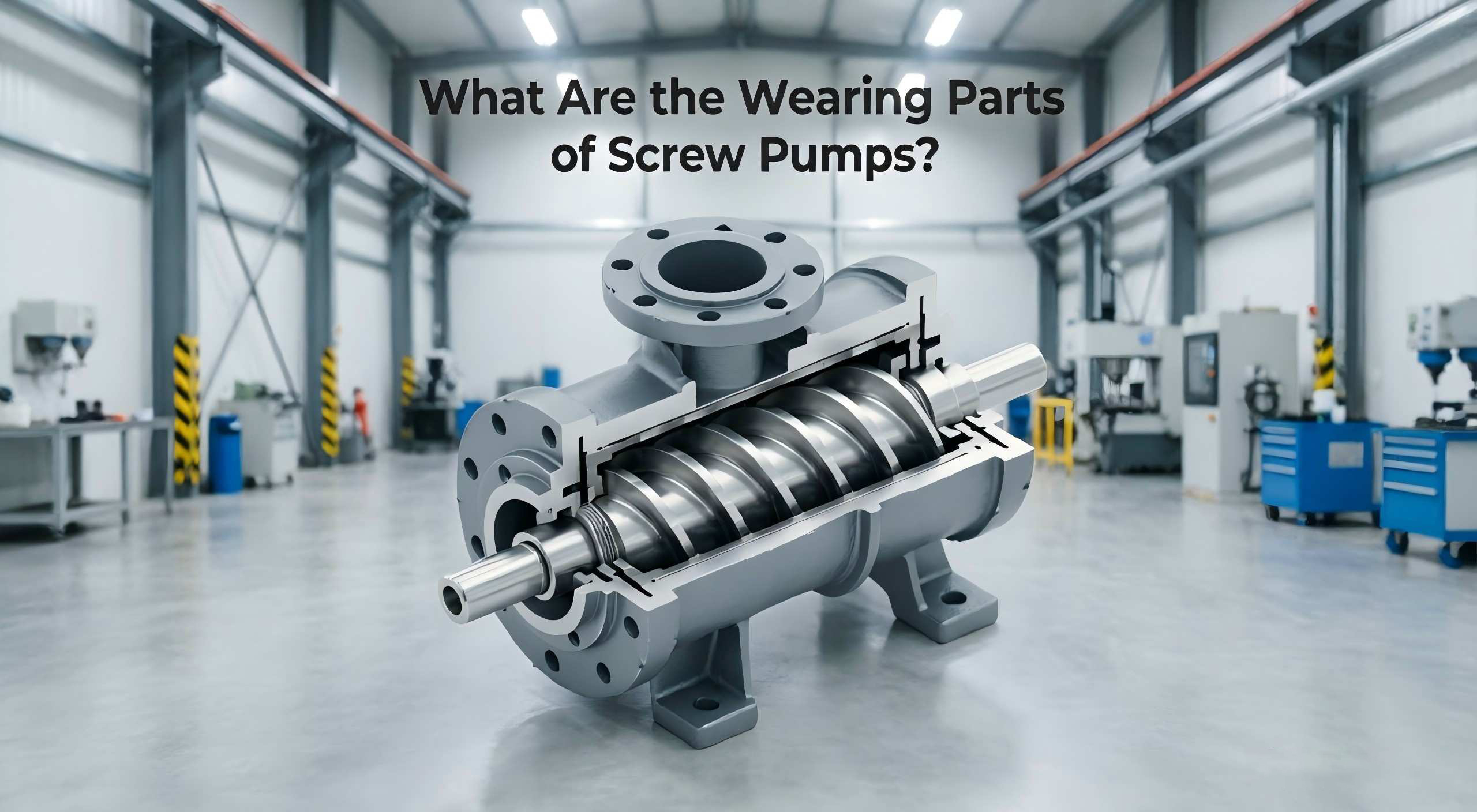
When talking about screw pump wearing parts, stators and rotors are the core and most frequently replaced components. During operation, the two fit tightly to form closed delivery chambers, which is the key to stable medium conveyance for screw pumps. Thanks to their minimal fitting clearance and high fitting degree, these components bear far higher frictional wear than other parts.
This also explains why dry‑running is strictly prohibited for screw pumps. During dry‑running without medium, there is no lubrication or buffering between the stator and rotor. The rubber stator will suffer abrasion, burning and cracking failure within a short time. To reduce friction during installation and operation, the common industrial practice is to evenly coat butter on the rotor surface during installation, so as to greatly lower assembly resistance and initial‑stage operating wear. In addition, the pump must be fully filled with feed liquid from the inlet before startup to ensure chambers are completely filled with medium and eliminate dry‑running wear. Under normal working conditions, the service life of stators ranges from 8000 to 15000 hours. Rotors offer better wear resistance with a service life of 12000 to 20000 hours. Wear of both components accelerates sharply under harsh working conditions.
Next to stators and rotors in wear frequency are universal joint assemblies, which serve as key structures for power transmission. Depending on screw pump structural models, some units are fitted with rubber protective sleeves, while others adopt steel protective sleeves. In long‑term operation, universal joints continuously bear torsional, tensile and impact loads, which may lead to enlarged clearances, loosening, jamming and wear. Rubber protective sleeves tend to suffer aging, cracking and corrosive damage, whereas steel sleeves may develop inner‑wall wear and deformation, further impairing transmission stability.
3. Connecting Rods, Intermediate Shafts and Drive Shafts
Connecting rods, intermediate shafts and drive shafts are connected in series to transmit motor power to the rotor and sustain continuous pump operation. Long‑term high‑speed transmission, load fluctuation and installation deviation may trigger shaft wear, loosening and coaxiality offset. These issues not only cause abnormal noise and vibration of equipment, but also aggravate abnormal wear of stators and rotors. They are regular wearing parts subject to medium‑and‑long‑term loss.
4. Mechanical Seals / Packing Seals
Sealing components are core parts preventing medium leakage of screw pumps. Either mechanical seals or packing seals can be selected flexibly according to properties of conveyed media. Mechanical seals, composed of rotating rings, stationary rings, springs and other structures, are mostly used for clean water and ordinary clean media. They can reliably block medium leakage and prevent air ingress into pump housings. For special media with high impurity content, strong corrosiveness or high viscosity, packing seals are mostly adopted for better adaptability and easier maintenance. Long‑term pressure fluctuation, medium corrosion and dry‑running jamming may result in seal failure, giving rise to shaft leakage and air infiltration. Seals are key components for routine inspection.
II. Quick Criteria for Diagnosing Damaged Wearing Parts
Faults can be rapidly identified via equipment operating status without professional testing instruments. Sharp drops in flow rate and pressure together with insufficient conveying capacity usually indicate aged and worn stators or rotors. Medium dripping and leakage from pump bodies mostly stem from failed mechanical seals or packing seals. Abnormal noise, vibration and jamming during operation generally point to worn or loose transmission components such as universal joints, drive shafts and connecting rods. Timely inspection and replacement can prevent minor faults from escalating into full‑unit shutdown.
III. Practical Tips to Reduce Wearing‑part Loss and Extend Equipment Service Life
Most screw‑pump components undergo normal wear. Nevertheless, standardized operation and scientific maintenance can substantially prolong service life. Fill the pump fully with feed liquid before startup and strictly avoid dry‑running. Properly coat butter on rotors during installation to mitigate assembly and operating friction. Match sealing types and component materials with conveyed media. Install pre‑filters for harsh media. Regularly inspect the condition of universal joints, shafts and seals, replace aged and damaged components in a timely manner, and implement lubrication maintenance for transmission parts. These measures can effectively cut operation‑and‑maintenance costs and secure long‑term stable equipment operation.
Conclusion
Major wearing parts of screw pumps include stators, rotors, universal joint assemblies, seals and transmission components. Among them, stators and rotors wear fastest and require priority attention. Standardized operation and periodic maintenance hold the key to reducing wear and ensuring stable operation.
Teffiko supplies full‑range original high‑quality screw pump wearing parts compatible with various working conditions, which can effectively lower failure rates and extend equipment service life. Should you have demands for model selection, replacement or maintenance, please contact us for professional technical support and one‑stop solutions.
We use cookies to offer you a better browsing experience, analyze site traffic and personalize content. By using this site, you agree to our use of cookies.Privacy Policy